Empty spool weights are the missing number in the most useful trick in 3D printing: weigh a spool, subtract the empty spool weight, and you know exactly how much filament is left. This page is a quick reference for the brands makers actually buy, split into plastic and cardboard spools.
Empty Bambu Lab spool: the reusable plastic spool weighs 250 g empty — measured on our own scale. Subtract it from any scale reading to get the grams of filament left.
Reference table
| Brand | Spool | Empty weight | Applies to |
|---|---|---|---|
| Bambu Lab | Reusable plastic | 250 g | All Bambu Lab filament |
| Bambu Lab | Refill | — | Filament coil only — wind it onto the reusable spool and use that spool's weight |
| Elegoo | Plastic | 155 g | Elegoo filament |
| eSUN | Plastic | 240 g | Most eSUN filament |
| eSUN | Heavy plastic | 278 g | HIPS |
| eSUN | Cardboard | 150 g / 165 g | Lightweight / reinforced cardboard spools |
| Hatchbox | Plastic | 210 g | Most Hatchbox filament (TPU: 220 g) |
| Inland | Cardboard | 142 g | Most Inland filament |
| Inland | Cardboard | 185 g | PLA Mystic Silk |
| Inland | Plastic | 215–224 g | Rainbow PLA (215 g); TPU, PC and fiber-filled ABS and nylon (224 g) |
| Overture | Plastic | 171 g | Most Overture filament |
| Overture | Cardboard | 163 g | Matte PLA, Super PLA+ |
| Polymaker | Plastic | 140–145 g | PolyLite, PolyMax, Panchroma and PolySonic PLA; PolyLite ABS, ASA and PC |
| Polymaker | Plastic | 125 g | PETG, PolyFlex TPU, PolyMide CoPA, PolyCast, PolySmooth, supports |
| Polymaker | Plastic | 175 g | Fiberon fiber-filled range |
| Prusament | Plastic | 210 g | Prusament filament |
| Sunlu | Plastic | 189 g | Standard Sunlu spools |
There's no safe rule of thumb. In this table, plastic spools run from 125 g to 278 g and cardboard ones from 142 g to 185 g — so a lightweight plastic spool can weigh less than a cardboard one. If your brand isn't listed, the only way to be sure is to weigh one empty spool and note it.
How to use these numbers
- Put the whole spool on a kitchen scale. Example: a part-used spool of Overture Matte PLA reads 612 g.
- Subtract the empty weight from the table — Matte PLA comes on Overture's 163 g cardboard spool: 612 − 163 = 449 g of filament remaining.
- Compare against your slicer's estimate for the next print. The full decision process is in the remaining-filament guide.
Why weights vary so much
Brands redesign spools to cut shipping weight, switch between plastic and cardboard for recyclability, and use different spools for different materials — Polymaker alone has four spool weights in this table. A 1 kg spool and a 250 g sample spool share nothing, and even "the same" spool can change between purchases a year apart. That's why a static table — this one included — is a starting point rather than gospel.
Or skip the lookup entirely
This table comes straight from the spool-weight catalog inside SpoolVault. Pick the brand and type when you add a spool, enter the total weight from your scale, and the right empty weight comes off for you. Custom spool weights are supported too — save one as the default for a brand you buy often.
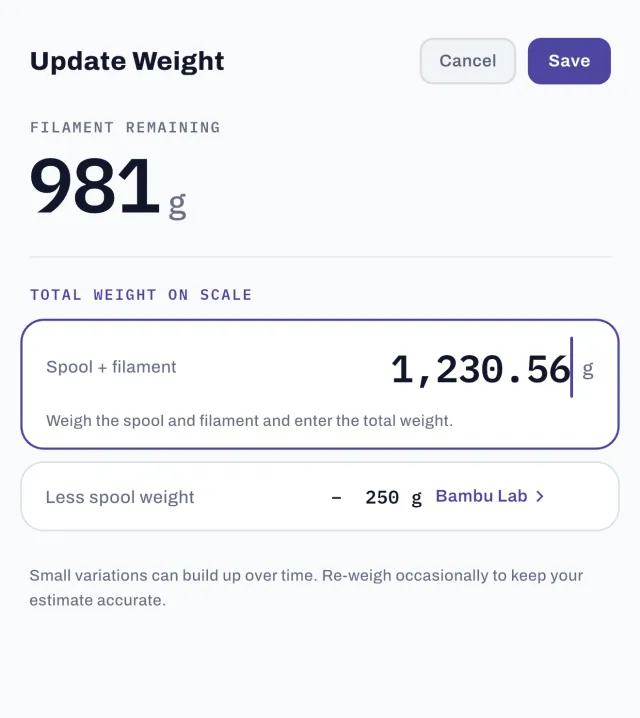
Every brand's spool weight, built in
SpoolVault turns one scale reading into grams remaining — for your whole stash.


 On a computer?
Scan with your
phone camera.
Free for 30 days — no subscription starts · iOS 15+ & Android 7+