If you're staring at a half-used spool wondering how much filament is left, there's one method that actually works: weigh the spool and subtract the weight of the empty spool. Everything else — eyeballing the winding, counting layers, trusting the printer's estimate — is a guess. The scale isn't.
The weigh-and-subtract method
You need a kitchen scale (or any scale accurate to a few grams) and one number: the empty weight of your spool.
- Weigh the whole spool, filament and all. Say it reads 894 g.
- Subtract the empty spool weight for that brand. An eSUN plastic spool is around 240 g, for example.
- What's left is filament: 894 − 240 = 654 g remaining.
That's it. No unspooling, no measuring the winding diameter, no plugins. The whole thing takes under a minute per spool.
What does an empty spool weigh?
This is the step people get wrong. Empty spool weight varies a lot by brand — from about 125 g to nearly 280 g across the brands we list, and a plastic spool isn't always heavier than a cardboard one. Use the wrong number and your estimate can be off by 100 g or more, which is the difference between "plenty left" and a print that dies at 92%.
We keep a reference table of empty spool weights by brand — Bambu Lab, eSUN, Hatchbox, Overture, Polymaker, Sunlu, Elegoo and more. If your brand isn't listed, weigh one empty spool when you finish it and write the number down; it'll be valid for every spool of that type you buy after.
How accurate is weighing a spool?
Very — usually within a few grams. The error sources are small: cheap kitchen scales are typically ±1–3 g, moisture absorbed by hygroscopic filament (Nylon, PETG to a lesser degree) can add a few grams, and spool weight itself varies slightly between batches. In practice you'll land within 1–2% of true remaining weight, which is more than enough to decide whether a print will finish.
Can I finish this print with what's left?
Your slicer already tells you the grams a print needs — it's in the print summary next to the time estimate. Compare that against your remaining weight, and leave a margin:
- Comfortable: remaining ≥ needed + 10%. Print it.
- Tight: remaining within ~5% of needed. Purges, primes and skirts eat into the margin — consider swapping spools or splitting the print.
- Not happening: needed > remaining. Better to know now than at 3am, layer 412.
Can I tell without a scale?
Roughly, at best. Some makers estimate from the winding depth left on the spool, or count spool turns and multiply by the circumference — but winding density varies, and both methods regularly land 20% off. A rule of thumb: if you can see the spool hub through the last layers of filament, you're usually under 150 g. For anything that matters, weigh it.
Weigh it once, keep it current
Weighing works, but doing the subtraction and remembering the result for twenty spools is where the system falls apart. That's the part SpoolVault automates:
- Empty spool weights for major brands are preloaded — enter the total weight on the scale and the spool's weight comes off for you.
- After each print, log the grams used and every spool's remaining weight updates automatically — you only need to re-weigh occasionally to stay calibrated.
- When you log a print, the app shows what each spool has available and what it will have left after, and flags a spool that won't cover it — so "will it finish?" is answered before you hit go.
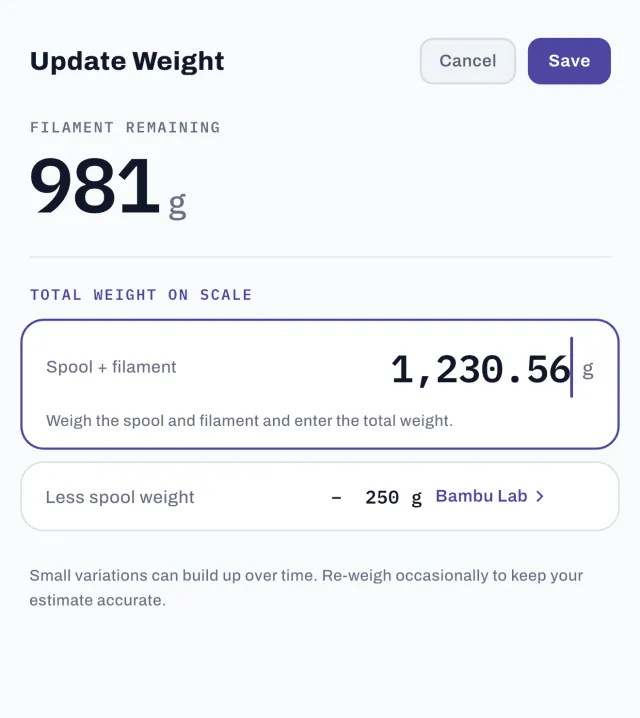
The weigh-and-subtract math, done for you
SpoolVault is a filament tracker for iPhone, iPad and Android, with empty spool weights built in for the major brands.


 On a computer?
Scan with your
phone camera.
Free for 30 days — no subscription starts · iOS 15+ & Android 7+