Filament cost per print comes down to one line of arithmetic: grams used × price per gram. Your slicer gives you the grams; your order history gives you the price. The interesting part isn't the formula — it's keeping real numbers flowing through it print after print, which is where most people quietly give up.
The formula, worked through
- Price per gram: a $24.99 spool of 1 kg PLA costs 24.99 ÷ 1000 = $0.025/g.
- Grams used: your slicer's print summary reports it — say 85 g for a decent-sized bracket.
- Material cost: 85 × 0.025 = $2.12.
Two honest footnotes. First, that's material cost — electricity, printer wear, failed prints and your time are real but separate line items (electricity is usually cents; failure rate matters more than most people think). Second, grams from the slicer are estimates; purge towers and prime lines on multi-color prints add real grams, which is one reason weigh-based tracking (see how much filament is left) keeps you honest over time.
Why the calculator habit doesn't stick
There are plenty of good free 3D print cost calculators online, and for a one-off quote they're fine. The problem is that every calculation starts from zero: you re-enter the spool price, the grams, sometimes the material density — for every print. Nothing accumulates. Ask "what did my printing cost last month?" and a calculator has no answer, because it never knew which spool you actually printed from or what you actually paid for it.
Costs that track themselves
SpoolVault flips the model: instead of a calculator you feed numbers into, the prices live on your spools. Enter what you paid when you add a spool (once), and then:
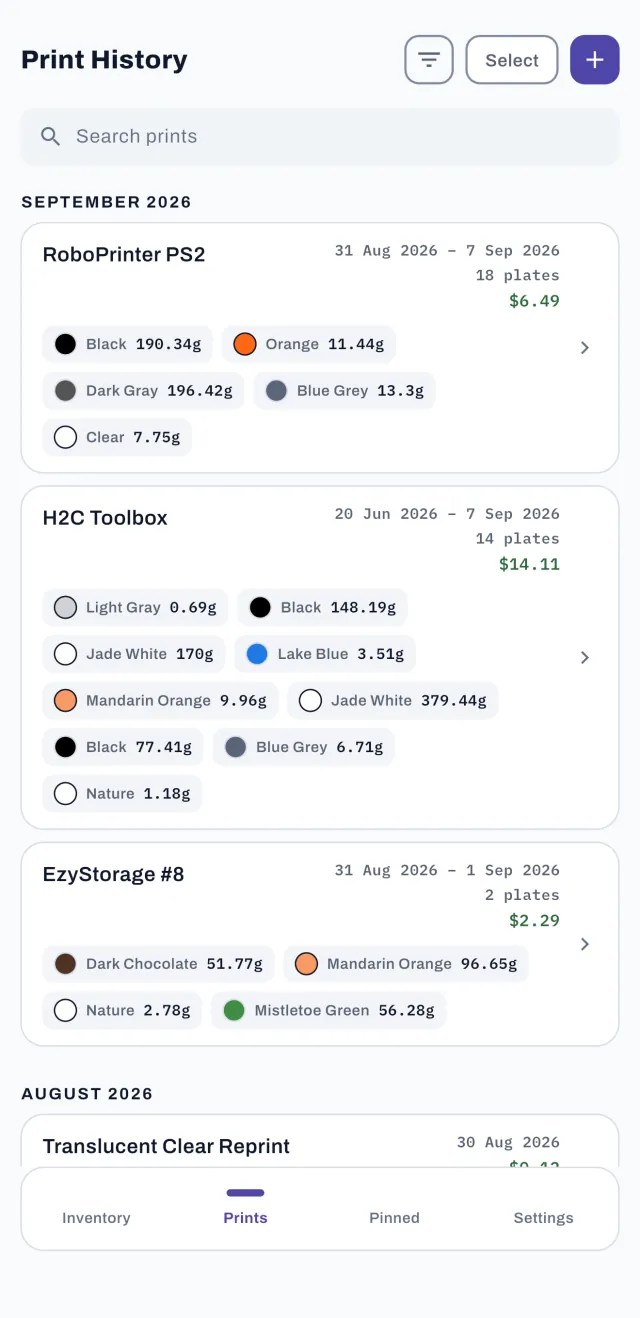
- Every logged print gets a real cost automatically — grams used × the actual price per gram of the exact spool you printed from, not a generic PLA average.
- Print history becomes a cost ledger — grams and dollars per print, scrolling back as far as you've been logging. "What did this month cost?" is a glance, not a spreadsheet session.
- Print Projects roll up multi-plate jobs — group the plates of a big build under one project and see total filament used, estimated cost, and the per-filament breakdown in one place.
- Mixed-material prints price correctly — each filament's grams are costed against its own spool price.
What should I charge for a print?
If you sell prints, material cost is the floor, not the price. A common starting structure: materials (from your actual cost log) + machine time at a modest hourly rate + your time for design, setup and post-processing + a failure allowance. What a running cost log contributes is confidence in the first number — quoting from real per-spool prices instead of "PLA is about $25/kg, probably".
Know what every print really costs
Prices live on your spools — every print you log gets a real material cost, automatically.


 On a computer?
Scan with your
phone camera.
Free for 30 days — no subscription starts · iOS 15+ & Android 7+